How to prepare our kids to the AI Era
A five-part LinkedIn series
A five-part series on LinkedIn about the skills we should help our kids build for the AI era, and how we might go about it, tested on the projects Hillel and I make together. Each post below links back to the original.
#1 Sensual experiences
Before we get caught up with all the rapid changes and threats to our livelihood and well-being from the urgency of agents pounding on our digital doors, we might want to spend a minute to think about the long-term effects of this revolution through the lens of the next generation. This generation will be the one that will actually live the consequences of this tectonic world shift. On a positive, constructive note, I will try to share my thoughts about key skills we need to build and strengthen with our kids for what’s to come, and maybe a head start on how we might go about doing so.
Each and every parent faces the challenge of the screen temptations that confront kids of all ages. We might lie to ourselves and come across the twisted thought that we are somehow building their digital literacy and preparing them for the digital world that surrounds them. Sadly this couldn’t be further from the truth. In the digital realm we can only be consumers, since soon enough the AI will be superior in each and every aspect of the digital realm. It’s like encountering a fish in the water with goggles and a snorkel. Our only advantage, for now, is our super advanced physical sensory feedback system: our senses, our ability to process sensorial data and our physical actuators (voice, touch). Humans who possess the ability to master those creatively (like wine tasting, building fragrances or creating pottery) will be super valuable (as also demonstrated by Moravec’s paradox).
In order to prepare our kids for those days we need to expose them to as many physical sensorial experiences as possible, as early as possible. To give them a chance to train their smell, their hearing, their touch and their sight on raw nature, which is the source of the most complex systems and sensorial stimulations. These are all senses we have been neglecting for far too long, while we overestimated the value of analytical and abstract skills. Exposing them to art of all kinds is also a way to encourage complex contemplation of the culture human history has bestowed upon us. At the end of the day, even while artificial entities do much of the actual work, the assessment, quality control and value proposition will (hopefully) remain in the hands of humans (for the most part).
I have always tried to expose my child to an abundance of stimuli as early as possible. Sound during pregnancy, adding smell and taste during infancy, touch, sight and vestibular during childhood. Soon the vast variety of human legacy might start to dwindle, so the more sensual memories we can stack up right now the better.
Here are some cool facts about our sense of touch.
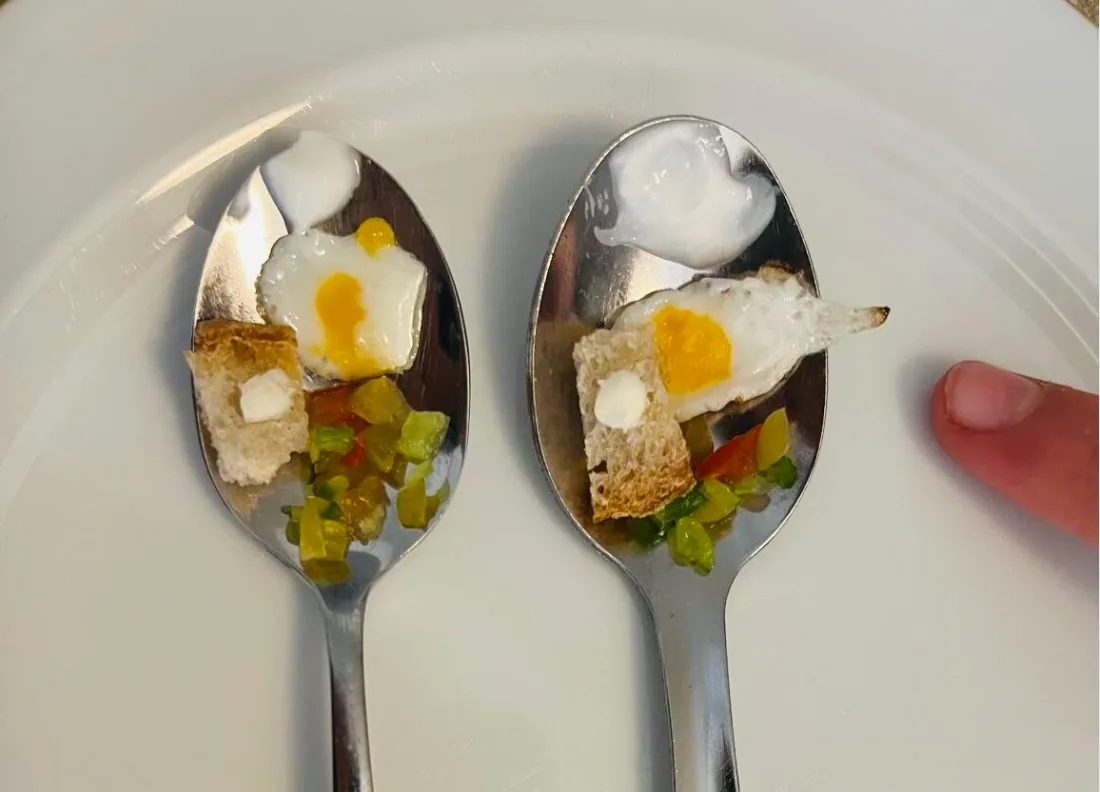
In the picture: my son’s mini breakfast (as part of his miniature food obsession :)
Read the original post on LinkedIn
#2 Multi potentialities
Before we get swept up in the urgency and disruption of agents at our digital doors, it’s worth pausing to consider the long-term impact of this shift through the eyes of the next generation, who will live its consequences. I’ll share some thoughts on the key skills we should help our kids build, and how we might start. (Emilie Wapnick: Why some of us don’t have one true calling)
The saying goes “Jack of all trades, master of none”, but what might seem to be intended as a slur might actually be a blessing in the AI era. Nowadays, when many of our skills can be supplemented by our AI counterpart, you might not need to fully master most skills; it just might be enough to get stuff done, and the more skills you are familiar with, the more AI skills you can match and complete. This should also give you a broader perspective on projects and a sanity check on the visions and ideas you want to make happen. We should encourage our kids to try out an abundance of skills. There is no need to home in on one skill and drill down on it; this approach might end up in narrow tunnel vision, following the “if you have a hammer everything looks like a nail” saying. Kids should know a bit of music, some structural engineering, 3D modelling, the clay turning wheel, electronics and much, much more. We should broaden our children’s horizons, as well as the different ways to combine skills creatively. Using 3D printing to create clay moulds, using electronics to play music and using code to create parametrically engineered structures. Well, you get the point.
As an industrial design graduate I enjoyed the exposure to many crafts during my studies, and the opportunity to try out my own ideas through those mediums of contemplation and expression. I have always regretted not mastering any specific skill, but today I value my understanding of an abundance of possibilities, and the ways to find innovation in combining them in unconventional ways.
In the video: I gave my (10-year-old) son a challenge to develop a game using one LED strip and one button.
Read the original post on LinkedIn
#3 Self reliance
With all the noise around agents showing up at our digital doors, it’s easy to get caught in the moment. But it’s worth taking a step back and asking: what does this mean for the next generation growing up into it? Here are a few thoughts on the skills we should be helping our kids build, and how to go about teaching them.
Whether you decide to join the AI party or the party against it, we need to realize that many of the institutions we are used to will have a hard time adapting to the changes AI is bringing, most probably including the education system (some would argue it stopped being relevant way before). This leaves us with the obligation to self-learn (and teach our children) many of the skills required to fit in and thrive in this new era. Self-learning and lifelong learning are some of the most important skills to master. We can already encourage our children to use digital assets and AI LLMs to self-learn not only knowledge but, more importantly, know-how. We should not focus only on what they need to know but also on the way to implement this knowledge using physical skills. This will expose them to an abundance of options and endless opportunities to grow and self-improve. The DIY world is full of instructional knowledge. The beauty of it is that knowledge you can only learn from a knowledge source, while know-how you learn from the doing itself. This will also encourage kids to experiment, fail, unlearn and relearn, through experiencing the full range of complexity the world has to offer. Self-learning by doing will also make them inherently question the world and the knowledge axioms previous generations have laid before them (the ones the AI relies on almost exclusively).
In general this puts less emphasis on the role of teachers and more on role modelling and mentoring, like in the good old days when a master would mentor their apprentice. Learning by mimicking and learning through real-life experience would change the fundamentals of what we call education. That’s how my son drilled his first hole when he was almost 3, and hammered his first nail about a year later.
Bonus video, a DIY guide to electric toy triggering, and one of our many toy-hacking projects (in the embed).
Read the original post on LinkedIn
#4 Project based learning
AI expands what any one person can do. You can delegate your weak spots to the relevant tool at hand. But that creates a new demand: someone has to hold the vision. Someone has to know what the whole thing is supposed to be and keep it on track.
That’s project management. And as the Peter Principle has long shown us, managerial ability is rarer than it should be. In an AI-augmented world, it becomes everything.
The way to build it in kids isn’t to teach it. It’s to have them run their own projects: small at first, growing in complexity, ambition and constraint as they grow. Constraints especially: there’s a reason the best work often comes from the tightest limits.
Every real project should move through the same motions: research and ideation → planning → prototype → testing → iteration, and so on.
That loop, practised young, builds something that no AI can shortcut: the judgment to know when something is working, and the resilience to keep going when it isn’t (or to reverse engineer the problems). Those projects, challenges and insights will equip them with the skills to manage their future AI multi-agent workforce.
Instructables is a brilliant place to start: a whole community sharing exactly this kind of real, hands-on project work across every level, domain and walk of life.
Bonus link: I gave Hillel, my son, hardware and a mission to make it walk. This is what came toddling out of it (in the video).
Read the original post on LinkedIn
#5 The physi digi liminal space
Last but not least, I believe most of the interesting innovation of the years to come will be placed in the dynamic space between the physical world and the digital one, and will constantly move between the two. In that liminal space there are a lot of great skills to play around with: 3D modelling and printing, VR and AR interfaces, electronic sensors and microcontrollers, robotics and more.
Experimenting with the flow between the realms, and researching new paths to make those shifts valuable, is paving the path for our future lives, economy and culture. Training children to be proficient in those fields, and comfortable moving between them, will give them a substantial advantage over their fellow humans and AI counterparts alike.
You might notice that many of the ideas in the How to prepare our kids for the AI Era series revolved around a small but unique community and culture: the makers community, which I am a proud member of.
I believe that being a part of this community, and exposing your kids (and yourselves) to the wonders this creative community has to offer (both in the what and the how), is the best way to prepare for the AI-dominant future that awaits us, and to ensure your value and leading role in it, together with your continued independence and creative freedom. It is a community of free-thinking, creating people that spans an enormous range of skills and all the possible permutations between them. It’s a community well versed in technology that decides to be playful, positive, proactive and inclusive of whoever has the will and endurance to join the crazy explorative journey. I believe this is the time for makers (and makers who don’t know they are makers, yet) to shine, and I encourage anyone and everyone to find the maker within them.
Small bonus: Gever Tulley’s “5 Dangerous Things You Should Let Your Children Do” (in the video below).
In the image: the small home-away-from-home treehouse project Hillel and I keep on improving, and hopefully will keep on working on for years to come.
Read the original post on LinkedIn
More of our projects: @hillel_and_saron on Instagram.